October 1st.
That's the date I need to have a draft of my dissertation done if I want to defend in December. OK. Sounds good to me.
While things are fresh in my mind, I want to record some of the things we talked about at my annual review. Becky was double-booked with another presentation this morning, so she was not there.
Rich gave me the admonition that now is the time to arm wrestle my data and the entire dissertation project and get it done. He complemented me on how I have sought to follow grounded theory's methods and remain open to my data and let it lead me where it will, but that now I need to begin to pull things together. I don't think he is advocating forcing the data, but instead saying that the time of openness and inquiry is passing and it is time to shift into analysis and findings--to develop my theory. I mentioned that while I am still open and inquirying with slice 5, I am pushing hard to get through this slice here in Lubbock and begin the end game of generating my theory. (That will be a subject of a future blog post, I am sure.)
Both Fred and Rich are interested the deep picture of what is going on for students within a writing assignment that my analysis is revealing. I showed them my refined version of my categories, properties, and dimensions and I used the analogy of a rubics cube to describe how these different categories and other elements fall into and out of alignment and even embed within each other. What I am gratified to hear is that the language I have chosen for my categories (fitting in bounds, essay success, coming to know, revision goals) were used by both Fred and Rich, and they seemed ok with them. They seem to grasp the concept and phenomena that the terms describe. That's good. I have been so close to these terms and using them so much that I am losing a sense of whether they work or not.
Interestingly, we had some discussion about time (or timing). Fred pointed out the diachronic and synchronic aspects of my study. I think what he is interested in is the diachronic aspect of my analysis--looking at the writing review in the context of the larger essay or draft cycle (and even the semester). Both Fred and Rich think I am digging into a perspective on student writing that has not been done very much, and it provides a unique perspective. What is often revealed are mismatches and discordances in the "system." I had just been looking at some of Spinuzzi's stuff on activity systems, so I referred to this classroom context of writing instruction as a kind of activity system. I spoke of a few cases I had seen where students misinterpreted the assignment, DI feedback did not critique following the assignment criteria, and the reflection was a total failure in terms of what we theoretically believe reflection will do (the value-added assumption of reflection). Fred referred to this phenomenon as "missing each other in the night" and as the "dark underbelly of composition." Mismatches and discordances occur due to poor views of essay success. So, Fred said, this research shows the importance of providing clear and available as well as concrete and detailed representations of essay success.
I had a few excerpts from Writing Reviews that we looked at together, and I narrated what I saw going on using the language of my categories. A couple of things came up from this discussion. I wanted to show cases where resolutions/goals were made and also instances where concrete steps were proposed to follow, but the student did not follow them in the next draft. In these WR, you can see instances of "coming to know" but then that knowledge does not extend (or transfer) into changes in the draft. Rich spoke of the importance of kairos or timing--that perhaps the time gap between the moments of realization and then working on the draft again led to unfulfilled resolutions. The moment of the coming to know should then be immediately followed by the act of application. He spoke of his believe in inserting the "teaching" of essay success right at the moment of realization and application and how that is what he has been wanting to create.
Fred also had some interesting things to say about the strategies these students were coming up with as their revision goals. He called them soft strategies. They mimiced the language of teachers using the words, but these were really like weasel words. They are really so vague that they are really expressing a true understanding at all. He mentioned S. I. Hayakoka's Language, Thought, and Action as having discussed this kind of use of language.
I had a few questions regarding my lit review and how I had framed my inquiry. Question 1 was whether linking my inquiry back to Young and his work on invention made sense. I want to anchor my inquiry into the questions Young had about invention back in 1978, showing how my inquiry has roots in a central concern of our field. They both thought it sounded ok.
The second and third questions focused on terms I had used to describe the gaps or problems in our field's understanding of reflection that in a sense justify my own inquiry. The first gap is what I call the value-added assumption of reflection and how we uncritically think that reflection will provide "value" or a benefit to students (and it is a certain kind of benefit). This gap and term for it seemed to check out ok too. I also think that our view of reflection is influenced by portfolios. We see reflection as a post-task constructivists activity, and don't conceive it in in-task terms. I call this the "portfolio-centric view of reflection." They both thought it sounded good too and rang true.
I think this about covers what we discussed. I know I am missing things. They both often referred to "this is the kind of thing to put in your chapter 5." I can't say right now I saw all the things that they did for what could go in there, but I think I can return to these possibilities when I get to chapter 5.
I still have a long way to go, but I am well-positioned to complete this project. But I will have to do some arm wrestling to get it done.
Wednesday, May 19, 2010


Monday, May 17, 2010
The May Workshop
So another May Workshop has begun, and I am once again sitting in a dorm room in Carpenter Wells. I want to write for a bit about what I hope to accomplish while I am here. Time is short, and time is long. I hope to make the most of this time.
I am on the verge. I am near the point where my research will come together, but I have a lot of work yet to do. Let me chart out what I see that I need to do with my grounded theory analysis.
Since I can't code the whole time, I thought at the same time (probably in the evenings) I would work on my methodology section. I may not be able to do all of the methodology because I have not finished my actual coding and thus reached the end of my coding, but I can at least pull together my rationale for this methodology better.
I have a few steps I think that this will involve. I can't quite see the sequence, but here are the tasks:
While I am here, I also want to get a good sense of what my real lit review chapter would be like. I have a section that seemed to be moving in a direction that would work in the dissertation, so I want to get some feedback to see if that direction is a good one to go in.
So I have three main goals
--GT analysis
--methodology drafting
--double-checking direction for lit review
Accomplishing these things will all need to be done, but it will position me for the summer work much better if I have managed to get this far. We shall see how it goes.
I will update along the way. In the meantime, it is a beautiful day outside with a clear blue sky, and I am still in my dorm room inside.
I am on the verge. I am near the point where my research will come together, but I have a lot of work yet to do. Let me chart out what I see that I need to do with my grounded theory analysis.
- I need to define my categories, properties, and dimensions.
- Then I need to analyze slice 5 with these "more consciously defined" categories
- I will then need to process this analysis along axial lines
- See if some core category truly emerges?
- Recode previous slices along axial lines to further clarify my sense of a core category and densify my categories and emerging theory
- See at this point if I need to do more coding
Since I can't code the whole time, I thought at the same time (probably in the evenings) I would work on my methodology section. I may not be able to do all of the methodology because I have not finished my actual coding and thus reached the end of my coding, but I can at least pull together my rationale for this methodology better.
I have a few steps I think that this will involve. I can't quite see the sequence, but here are the tasks:
- Review previous drafts of rationale and methodology description
- Review other dissertations to see their description of the methodology and see what goes into a methodology section
- Review other readings I have related to GT to see what other kinds of rationale I can use
- Begin drafting/redrafting the chapter
While I am here, I also want to get a good sense of what my real lit review chapter would be like. I have a section that seemed to be moving in a direction that would work in the dissertation, so I want to get some feedback to see if that direction is a good one to go in.
So I have three main goals
--GT analysis
--methodology drafting
--double-checking direction for lit review
Accomplishing these things will all need to be done, but it will position me for the summer work much better if I have managed to get this far. We shall see how it goes.
I will update along the way. In the meantime, it is a beautiful day outside with a clear blue sky, and I am still in my dorm room inside.
Saturday, May 15, 2010
Plato and "Essay Success"
Has it all come back to Plato? This morning as I pondered over my concepts and emerging theories of how they relate to each other, I came back to Plato (with a bit of horror). I am deeply worried that I am reducing my theorizing into an ancient box, but for the moment I will explore this connection for what it is worth.
A possible "core category" for my theory is what I have called "essay success" (or "writing success"). The concept of essay success, however, seems to fit this school context since it encompasses other aspects of the task than just the writing. Everything is permeated with the influence of the concept of essay success. What problems are identified and recognized come from notions of essay success. What assessments and evaluations are made about the essay as well as the process of composing or the goals for revision are gauged against this notion of essay success. What counts as "coming to know" is that which is closest to essay success.
I have charted out that essay success related to conceptions of the ideal text and the real text. The ideal text equals a fulfillment of essay success; however, the writer's as well as the responder's grasp of ideal text is often (or how about always) imperfect. Likewise, our apprehension of the real text is also an imperfect representation. Peer response is a kind of measuring and matching of the real text against the ideal text. An imperfect understanding of either (or both) leads to difficulties.
These are the kinds of conceptual musings I have been doing with my categories, and it hit me as a kind of recognition that all of this business about essay success sounded a lot like Plato's notions of the Forms (or Ideas). Oh no. While I certainly don't ascribe to the belief that the Forms are immortal and unchangeable and live up in the Empyrean Heaven, I can see that they are another way of articulating the notion of mental models, schema, or representations (so often used by the cognitivist). Task representation. Well, that representation is based upon a mental picture and understanding of the task. What is this mental picture? this mental representation?
Plato, just as I have noticed the significance of this mental model, uses an analogy to communicate this importance. He sets up three components:
--the power of sight (our capacity to apprehend or take in, perception, what is inside us)
--the visible (outside reality)
--light
He states, "If sight is in the eyes, and the possessor tries to use it, and if color is in the things, you know, I suppose, that it will see nothing and the colors will be unseen unless a third thing is there specially created for this purpose" (Republic, VI 507B).
This third thing is light. We see nothing and the visible is not seen unless there is light. Of course, this view contradicts premises of positivistic science which believes no third thing is necessary. Observation is direct and unmediated. Plato may be fairly post-modern (ironically) here since he is saying that our "sight" is mediated and even enabled by something else. For him, it is the Forms--this ideal, abstract conception of things that serves like light to help us see (within ourselves) and makes apparent qualities of reality. Here is Plato making the comparison between the influence of light and knowledge:
"my meaning must appear to be that this, the offspring of the good which the good begat, is in relation to the good itself an analogy, and what the good effects, by its influence, in the regions of the mind, towards mind and things thought, this the sun effects, in the region of seeing, towards sight and things seen" (Republic, VI 508D).
The effect of "the good" is like the effects of light for our seeing. Plato goes on, then, to articulate a theory of epistemology from this analogy: "when it [the soul] settles itself firmly in that region in which truth and real being brightly shine, it understands and knows it and appears to have reason. ...Then that which provides their truth to the things known, and gives the power of knowing to the knower, you may say is the idea or principle of the good, and you must conceive it as being the cause of understanding and of truth in so far as known" (Republic, VI 508D-E). He goes on to distinguish knowledge and truth AS WE KNOW them are not the good. They are good-like.
 Here is a scan of Plato's chart of this relationship.
I think I would need to dig deeper into Plato to get what the heck he is meaning with his equation.
What I think Plato gets at here, and it is exactly what I have been noticing, is the influence of the conception of "the good" or in this case "essay success"--the good piece of writing. He even goes so far as to say that the good is the cause of knowledge:
"Similarly with things known, you will agree that the good is not only the cause of their becoming known, but the cause that knowledge exists and of the state of knowledge, although the good is not itself a state of knowledge but something transcending far beyond it" (Republic, VI 508E). "Coming to know," realizing, figuring things out, seeing now, understanding all are rooted in the good. What counts as knowledge? That which is in alignment with the good.
So where does reflection come in? How does this work within the Writing Reviews. I can't say that this "thinking" only resides or is exclusively present in writing reviews, but what is happening is purely contrastive. Put this up to that. Contrast your text to the image of the ideal text in my head. Reflection, as Dewey noted, involves a "double-movement" which basically goes from the world to our conception of the world. It is out of this contrastive double-movement that I see students "coming to know." This fitting in bounds is the epistemological nature of reflection in the writing classroom.
I don't know if by bringing in Plato's thinking I am helping or not, but I can certainly see parallels between his connection of the Forms to knowledge and my own connection of essay success to what students learn. But I have to think about all this more... . Certainly this theory of epistemology has been critiqued by others.
A possible "core category" for my theory is what I have called "essay success" (or "writing success"). The concept of essay success, however, seems to fit this school context since it encompasses other aspects of the task than just the writing. Everything is permeated with the influence of the concept of essay success. What problems are identified and recognized come from notions of essay success. What assessments and evaluations are made about the essay as well as the process of composing or the goals for revision are gauged against this notion of essay success. What counts as "coming to know" is that which is closest to essay success.
I have charted out that essay success related to conceptions of the ideal text and the real text. The ideal text equals a fulfillment of essay success; however, the writer's as well as the responder's grasp of ideal text is often (or how about always) imperfect. Likewise, our apprehension of the real text is also an imperfect representation. Peer response is a kind of measuring and matching of the real text against the ideal text. An imperfect understanding of either (or both) leads to difficulties.
These are the kinds of conceptual musings I have been doing with my categories, and it hit me as a kind of recognition that all of this business about essay success sounded a lot like Plato's notions of the Forms (or Ideas). Oh no. While I certainly don't ascribe to the belief that the Forms are immortal and unchangeable and live up in the Empyrean Heaven, I can see that they are another way of articulating the notion of mental models, schema, or representations (so often used by the cognitivist). Task representation. Well, that representation is based upon a mental picture and understanding of the task. What is this mental picture? this mental representation?
Plato, just as I have noticed the significance of this mental model, uses an analogy to communicate this importance. He sets up three components:
--the power of sight (our capacity to apprehend or take in, perception, what is inside us)
--the visible (outside reality)
--light
He states, "If sight is in the eyes, and the possessor tries to use it, and if color is in the things, you know, I suppose, that it will see nothing and the colors will be unseen unless a third thing is there specially created for this purpose" (Republic, VI 507B).
This third thing is light. We see nothing and the visible is not seen unless there is light. Of course, this view contradicts premises of positivistic science which believes no third thing is necessary. Observation is direct and unmediated. Plato may be fairly post-modern (ironically) here since he is saying that our "sight" is mediated and even enabled by something else. For him, it is the Forms--this ideal, abstract conception of things that serves like light to help us see (within ourselves) and makes apparent qualities of reality. Here is Plato making the comparison between the influence of light and knowledge:
"my meaning must appear to be that this, the offspring of the good which the good begat, is in relation to the good itself an analogy, and what the good effects, by its influence, in the regions of the mind, towards mind and things thought, this the sun effects, in the region of seeing, towards sight and things seen" (Republic, VI 508D).
The effect of "the good" is like the effects of light for our seeing. Plato goes on, then, to articulate a theory of epistemology from this analogy: "when it [the soul] settles itself firmly in that region in which truth and real being brightly shine, it understands and knows it and appears to have reason. ...Then that which provides their truth to the things known, and gives the power of knowing to the knower, you may say is the idea or principle of the good, and you must conceive it as being the cause of understanding and of truth in so far as known" (Republic, VI 508D-E). He goes on to distinguish knowledge and truth AS WE KNOW them are not the good. They are good-like.

I think I would need to dig deeper into Plato to get what the heck he is meaning with his equation.
What I think Plato gets at here, and it is exactly what I have been noticing, is the influence of the conception of "the good" or in this case "essay success"--the good piece of writing. He even goes so far as to say that the good is the cause of knowledge:
"Similarly with things known, you will agree that the good is not only the cause of their becoming known, but the cause that knowledge exists and of the state of knowledge, although the good is not itself a state of knowledge but something transcending far beyond it" (Republic, VI 508E). "Coming to know," realizing, figuring things out, seeing now, understanding all are rooted in the good. What counts as knowledge? That which is in alignment with the good.
So where does reflection come in? How does this work within the Writing Reviews. I can't say that this "thinking" only resides or is exclusively present in writing reviews, but what is happening is purely contrastive. Put this up to that. Contrast your text to the image of the ideal text in my head. Reflection, as Dewey noted, involves a "double-movement" which basically goes from the world to our conception of the world. It is out of this contrastive double-movement that I see students "coming to know." This fitting in bounds is the epistemological nature of reflection in the writing classroom.
I don't know if by bringing in Plato's thinking I am helping or not, but I can certainly see parallels between his connection of the Forms to knowledge and my own connection of essay success to what students learn. But I have to think about all this more... . Certainly this theory of epistemology has been critiqued by others.
Saturday, May 1, 2010
The Conceptualization of Data

Judith Holton in an article titled "The Coding Process and Its Challenges" within the Sage Handbook of Grounded theory sums up grounded theory and the coding process: "The conceptualization of data is the foundation of grounded theory development. The essential relationship between data and theory is the conceptual code" (266). It sounds simple, right? Who knew that in that little word "conceptualization" lay all the misery and mystery of research, as well as the source of so much disagreement.
This blog post won't examine many of Holton's interesting propositions about grounded theory as its own research paradigm or her thoughts about pre-conceptualization. Instead, I want to write for a few moments on the subject of description and conceptualization. Holton states: "To understand the nature of classic grounded theory, one must understand the distinction between conceptualization and description. Grounded theory is not about the accuracy of descriptive units, nor is it an act of interpreting meaning as ascribed by the participants in a study; rather, it is an act of conceptual abstraction" (272). Holton attempts in her article to distinguish GT from qualitative research methodologies, and you can see her do it in this quote surrounding the issue of description and interpretation. While I think her differentiation of GT from qualitative research is interesting, I am more interested in her discussion about the movement beyond description toward conceptualization.
I have struggled with this issue of moving beyond description in my own research. Corbin and Strauss stress that naming and labeling is a first step of open coding, yet it seems more mysterious as to how to arrive at "codes" that are conceptual in nature and not merely descriptive. Holton warns that those of us trained in qualitative research may latch onto what she calls "descriptive coding" "with its capacity to portray rich detail, multiple perspectives, and the voices of lived experience" (272). I have certainly felt this descriptive pull and done my fair share of it. At times I feel as if I'm lingering on the "ground" level of description waiting for the wings of conceptualization to pop up on my back and enable me to fly. Perhaps this flight will still happen.
Reading Holton, however, provided me with one anchor for this conceptualization process that I think I might find helpful. She is admittedly a Glaserian "classic" grounded theorists, and I have spent more time studying and using Strauss and Corbin as my guide (though I consider Dey a neutral mediator), so I hope that I don't "mix my method" by incorporating some of Glaserian practice. But Holton brings up Glaser's notion of the "concept-indicator model." I was not familiar with it (or had forgotten it), but it make sense. Holton gives an example of a number of in vivo, descriptive codes. The researcher then looks at these codes and asks, "What concept might these indicate?" What concept might these descriptive items/features indicate or be described by in a more abstract sense?
I am seeking to delineate the categories, properties, and dimensions of my data, so which comes first? The property or the category? Are properties the "indicators" of a concept (and a concept is the heart of a category)? Or do you get your category first and them map out its properties and dimensions? It all seems messy because I don't think this conceptualization process happens sequentially, nor can description ever be free of elements of conceptualization. Holton seems to acknowledge the messiness of this activity, and affirms that it is GT's methods that are most important to trust and follow through this process:
"The chaos is in tolerating the uncertainty and subsequent regression of not knowing in advance and of remaining open to what emerges through the diligent, controlled, often tedious application of the method's synchronous and iterative processes of line-by-line coding, constant comparison for interchangability of indicators, and theoretical sampling for core emergence and theoretical saturation" (273).
Chaos and uncertainty indeed. She calls GT a form of discipline, and she is right. I am getting more comfortable with this messiness and with the procedures of this methodology, and that includes becoming more at ease with the uncertainty. Interestingly, Holton brings up one warning that Glaser talks about related to when researchers begin to generate concept (true concepts!) from the data. They talk about an excitement that happens: "Captured by the imagery, or 'grab' (Glaser, 2001: 19-21) of the emerging concepts, they [the researcher(s)] switch their attention from abstraction to description" (273). It sounds like a possible danger is to jump back into the descriptive level to use the concept as an integrative descriptive tool too soon. I must remember not to do this.
Monday, April 12, 2010
Spinning wheels
I don't know if the hot yoga cooked my brain yesterday or what, but I had trouble thinking this morning as I wrestled some more with my categories. It has come to me that I can group a number of categories together under one umbrella, but I'm struggling with the name for this grouping. I can say with clarity that I have seen this grouping or dynamic from the very beginning of my coding, and in fact slice #2 focused almost exclusively on this cluster. I showed it to my wife, and she said it reminded her of what they call algorithms in her pediatric references--there are certain elements and the flow between them varies. Here is the graphic of this algorithm for writer's reviews again:
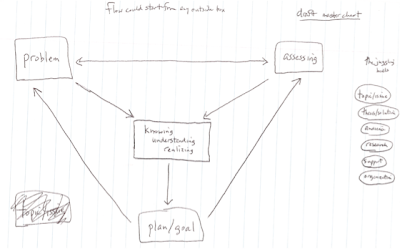 I saw that I could chunk writing reviews into sets of these algorithms. A single WR would move from topic to topic and variously go through this sequence. For the most part they cycle toward the end point of "coming to know" and formulating a "revision goal." I think I will be redoing this diagram, but these categories that work together within this algorithm are:
--problem thinking
--feedback thinking
--assessing/reassessing
--coming to know
--revision/fixing thinking
What to call this cluster? I think this legitimately counts as a category because they all share these common elements, but at this point I can think of nothing more clever that "review topics." Categories are supposed to be conceptual in nature. That is not conceptual. What are they doing? What is happening? They are addressing writing issues and figuring out what to do about them. The one benefit of "review topics"is that it aligns with the prompt-determinism within all these Writing Reviews. Despite this prompt determinism, I can still see this dynamic at work. Maybe "addressing a writing issue." But sometimes the WRs ask to address topics that related to feedback or research. I'm still wrestling with this terminology.
I am also wresting with how to handle the "telling/reporting what is" vs. "considering/evaluating what is" dichotomy. This dynamic is important because I believe it marks the divide between awareness and reflection, between representing reflective thinking and engaging in it. It occurred to me in the shower (no kidding) that perhaps these two qualities operate on the dimensional level. I can have problem thinking on audience which could be reported thinking or it could be presently considered. The category or subject does not change, but it could be considered in either of these two ways. Hmm. I will have to see how this way of representing the data will work. I also have struggled about where to place the very important concepts of "fitting in bounds" and "essay/writing success." Are essay success and writing success sub-categories of "fitting in bounds." OR is the concept of essay success again something that operates on the dimensional level. Whenever a writing issue is considered or problem identified or plan conceived, EVERYTHING is gauged against the concept of essay success. It is the ultimate goal and arbiter of everything.
I'm just not sure how or where to fit "essay success" into the dynamic. I'm halfway tempted to make it the core category, but I'm this cluster I have talked about here might be the core category.
I'm struggling here because I feel that I am leaping out of open coding into axial coding and it hurts my brain.
I don't really like these terms as yet.
Wednesday, April 7, 2010
Pushing down on mercury
I'm struggling with the slippery aspects of my coding right now. My goal is to try and nail down my categories (add any if necessary) and then work out properties and dimensions. It isn't easy. However, I am seeing in slice 5 so far a very familiar pattern revolving around problem identification and "resolution." This pattern is one I identified in slice 2, and I charted out the many paths a student follows as they move from problem to "coming to know" and then declaring a revision goal.
My mind is so full of all the stuff going on that I think for the moment I will focus on one aspect of this dynamic I have seen in the draft cycle from my 1301 student #2. He had four problem identification-resolution cycles in his Writing Review. The first was short, but the other three were fairly extended. This dynamic seems to center around conflicting views between outside and inside the writer, and the entire dynamic is mitigated or driven or regulated by the abstract criteria of "essay success" (which could be more general "writing success" outside of the particular goals/criteria for the essay task).
Here are the three
Sequence A: problem = thesis
Feedback--not there <<<>>> Author--thought it was there
-------conflicting views---------------
Resolution
a--take authorities word for it (they are right)
b--self-check and confirm (COMING TO KNOW)
Revision Goal--make strong thesis
Sequence B: problem = contradiction
Feedback--you tend to contradict (id instance)<<<>>> Author--tried to avoid
*expresses doubt or disbelief they did it when they were trying expressly not to*
Resolution
a--take authority's word for it
Revision Goal--fix contradiction
Sequence C: problem = to casual, use of generic "you"
Feedback--too casual/you <<<>>> Author--double-checks and agrees
*agreement on problem*
COMPLICATION FOR RESOLVING PROBLEM
criteria of writing success--relate to reader vs. how to reach goal without using "you"
Resolution
a-take authority's word for it
Revision Goal--avoid "you"
I can notice a few things in these three patterns. First, there seems to be more negotiation or consideration revolving around the problem. Only the third sequence had any sort of complication about the solution and that was more a matter of facing a goal and not knowing how to get there without getting in trouble. Little or no extended consideration is given to the revision goals. I could do this or I could do that. If I did this then it would result in X, but if I did that it would result in Y. I think Y would work better because... . None of this "reflective thinking" occurs. Instead, the writer like a compass pointing to true north follows the view point of an authority. I am calling this phenomena right now [taking authority's word]. I might call it taking other's word for it. Rather than taking my word for it.
Authority's word is like a trump card. What is the source of their trumping power. Well, it is the power to grade and it is their power as arbiter of the criteria for essay success. They possess both the vision of this abstract essay success, but presumably they possess better skills at enacting that success than the student so when they speak you'd better listen.
I don't know if I am getting at anything interesting yet, but I am working at it. I am targeting getting materials ready to do a round of peer debriefing on my categories as soon as I can do it. Soon!
Friday, April 2, 2010
Coding: Of Categories, Properties, and Dimensions
As Ian Dey notes, the conceptual elements of categories, properties, and dimensions can be a muddle and the distinction between them can get confused. Since one of my main goals with this slice 5 will be to code categories and sub-categories for their properties and dimensions, I am seeking with this post to clarify distinctions and definitions (so I know what I’m doing). I hope to establish a loose anchor to guide my coding in this post: that is, a framework for analysis that is not too rigid or mechanistic, but one provide general guidance that allows for flexibility in discovery. Yet, I don’t want this framework to be so loose that I wander through my analysis making contradictions all along the way.
Guiding Principle
Let it happen.
“An analyst is coding for explanations and to gain an understanding of phenomena” (Strauss and Corbin 129).
Strauss and Corbin describe the confusion that exists for analysts as they rigidly try to categorize things/events into the boxes of their coding, especially when they code the same event or happening in two different ways. They state, “We realize that beginners need structure and that placing data into descrete boxes makes them feel more in control of their analyses. However, we want them to realize that such practices tend to prevent them from capturing the dynamic flow of events and the complex nature of relationships that, in the end, make explanations of phenomena interesting, plausible, and complete” (129). They advise “to let it happen.” Rigor and vigor, they say, will follow.
Categories
A category is an abstract label used as a heading or name for a class of objects, events, happenings that share similar characteristics. It is the most logical descriptor for what is going on. The distinction between “concept” and “category” can be confusing. In a sense, all coding (categories, properties, dimensions) is conceptual in that you are creating an abstract representation of the phenomena. Categories are said to be groupings of concepts that are labeled or named phenomena by like or similar characteristics. Dey presents a good critique of this generation of categories through groupings according to similarities and differences, and says we must be more reflective about how we generate and use them (255).
Strauss and Corbin--
“Categories: Concepts that stand for phenomena.” (101)
Dey:
“Category—used as a way to identify or distinguish something based on comparisons with other things.” (252)
Sub-categories
Sub-categories specify a category more by denoting information such as when, where, why, and how. It seems like the notion of sub-categories and properties might be confusing. If for example, we had the category “drug using” (example from Strauss and Corbin), then a sub-category might be “types of drugs.” Grouped within “types of drugs” would the different drugs (cocaine, pot, ecstasy ect.). These sub-categories would then have properties such as forms, effects, how used. We shall see about sub-categories. (I think I need to see more examples.)
Strauss and Corgin offer a definition of sub-categories:
“Subcategories: Concepts that pertain to a category, giving it further clarification and specification.” (101)
Properties
Properties are the recognizable characteristics or attributes or the phenomena. These attributes determine how it is classified or categorized.
Strauss and Corbin simply state properties are the
“Characteristics of a category, the delineation of which defines and gives it meaning.” (101)
Dey--
“Property—used to ascribe a quality or attribute to something based on analyzing its interactions with other things” (252)
Again, I am somewhat unclear how to distinguish a sub-category from a property.
Dimensions represent the location of a property, that is a characteristic or attribute, along a continuum or range. Dimensions measure degree, not kind.
Strauss and Corbin--
“The range along which general properties of a category vary, giving specification to a category and variation to a theory.” (101)
Dey--
“Dimensions—used to measure extension.” (252)
So we have a few examples of the category, property, dimension breakdown:
Category: Color
Properties: shade, hue, intensity
Dimensions: high/bright----low/faint
(from bright shade to faint shade, from high hue to faint hue, from high intensity to low intensity)
Category: Orange (as in fruit)
Properties: size, color, shape, weight, cost
Dimensions: high/big/bright----low/small/faint
(large size to small size, bright color to faint color, big shape to small shape?, high cost to low cost)
The problem with these examples of categories, properties, and dimensions is they are of THINGS and not PHENOMENA. Still they are helpful in seeing the relationship between properties and dimensions. Dimensions provide the description of variation and degree of phenomena.
Dey ends his book by quoting what Strauss and Corbin identify as the central features of the grounded theory methodology. I will present these in list form:
1. the grounding of theory upon data through data-theory interplay
2. the making of constant comparisons
3. the asking of theoretically oriented questions
4. theoretical coding
5. the development of theory (269)
So my quest in this next slice of coding will be to articulate the properties of my categories more explicitly and identify the dimensions or range that these attributes fall within. This post has helped my establish distinctions I can use in my analysis, but I must remember that these distinctions remain a loose anchor and my overall goal remains to “coding for explanations and to gain an understanding of phenomena” as best I can.
My goal will be next to begin my coding discuss my own categories along these lines of properties and dimensions.
Subscribe to:
Posts (Atom)
-
 Pre-dissertation Proposal Lennie Irvin Ph.D. Student in Technical Communication and Rhetoric, Texas Tech University Identify the Problem Req...
-
"Collaborative Learning and the Conversation of Mankind" by Kenneth Bruffee Reading this article again, I am amazed at how much of...
-
As Ian Dey notes, the conceptual elements of categories, properties, and dimensions can be a muddle and the distinction between them can get...